
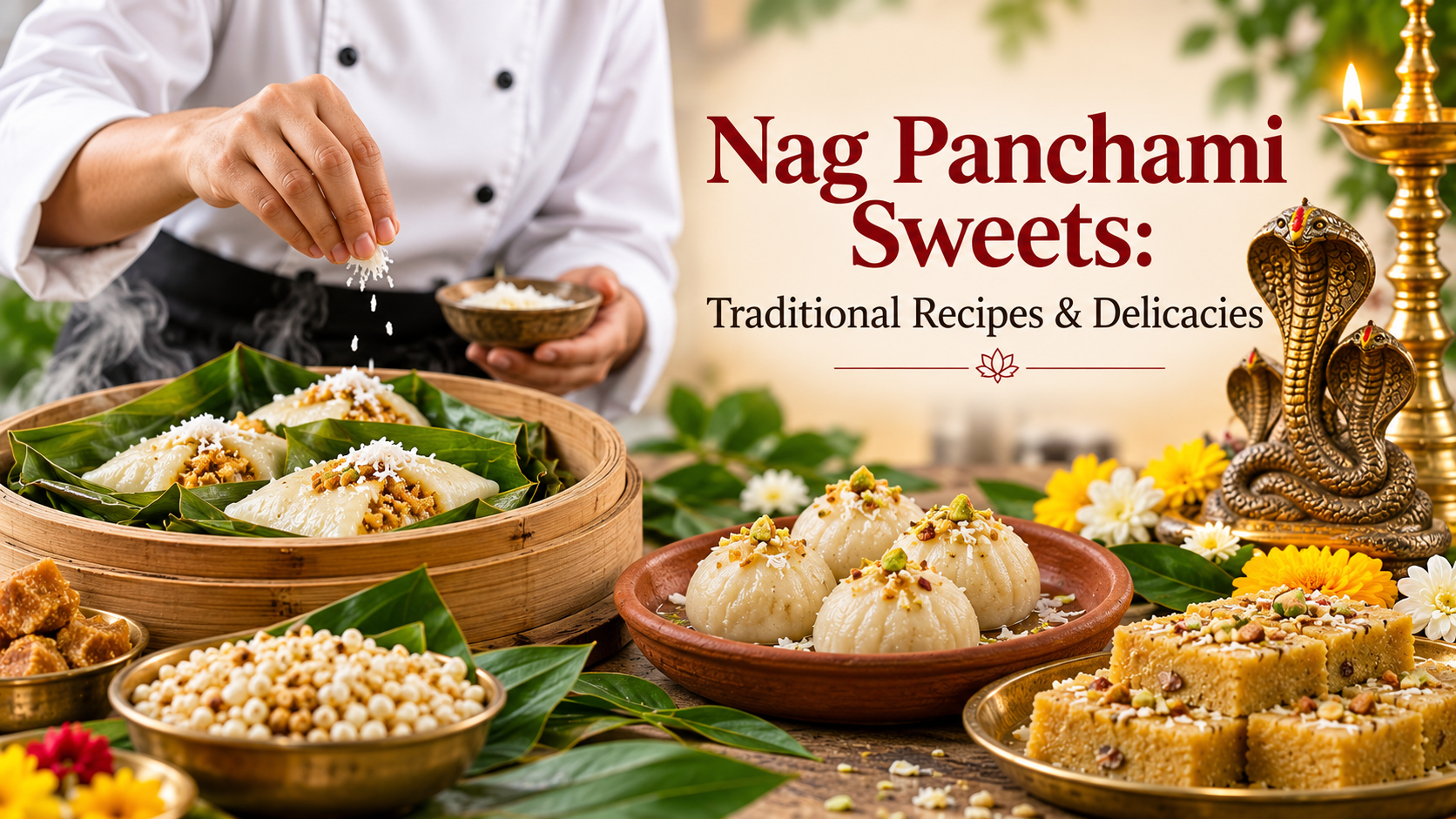
The Sacred Flavors of Nag Panchami: A Deep Dive into Traditional Sweet Dish Delicacies and Rituals
Explore the sacred culinary traditions of Nag Panchami, Nag Panchami Sweets featuring delicacies like Purnache Dind. Discover why the iron tawa is forbidden and how ancient grains nourish the soul.
The monsoon winds of Shravan carry more than just rain—they bring with them an ancient covenant between humanity and the earth’s hidden guardians. On Monday, August 17, 2026, millions across India will observe Nag Panchami, the fifth day (Panchami) of the bright half (Shukla Paksha) of the lunar month of Shravan, when the serpent deity (Nag Devta) is worshipped with milk, flowers, and a distinctive array of satvik sweets prepared without frying or the use of an iron tawa. [economictimes.indiatimes]
This is not merely a festival of devotion; it is a culinary philosophy encoded in jaggery, rice batter, and popped sorghum—a gastronomic expression of ecological wisdom that has sustained Indian civilization for millennia. [slurrp]
The Mythological Tapestry: Why Nag Panchami Matters
To understand the food of Nag Panchami, one must first understand the myth that gives it meaning. The festival is deeply rooted in the Samudra Manthan (the churning of the cosmic ocean), where the serpent king Vasuki served as the churning rope. When the lethal poison Halahala emerged, threatening to destroy creation, Lord Shiva swallowed it to save the universe. [hinduhub]
The intense heat and toxicity within Shiva’s throat required cooling, and devotees began offering milk to soothe the deity—and by extension, the serpent who endured the friction of the churning. This mythological “cooling” dictates the human diet for the day: milk and water-based sweets are consumed to balance the internal humidity and heat of the Shravan season, when digestive fire (Agni) is naturally low.
In the eyes of a culinary anthropologist, mythology provides a structural framework for seasonal dietary habits. The timing of Nag Panchami coincides with the peak of the monsoon, a period where the digestive system is vulnerable, necessitating a satvik (pure, non-agitating) diet that is cooling and easily digestible. [slurrp]
The Architecture of Devotion: Sacred Food Rules and Taboos
In the traditional Indian kitchen, ritual restrictions act as a form of sensory discipline. On Nag Panchami, the satvik philosophy governs every movement of the halwai (sweet-maker). [slurrp]
The “No-Tawa” Mandate
The most striking restriction is the absolute prohibition of the iron tawa (griddle). In the sacred geometry of the kitchen, the round, flat tawa is a symbolic representation of the serpent’s hood. To place it over fire and scrape it with a spatula is seen as a profound act of disrespect to the Nag Devta.
Astrologically, iron is linked to the planet Rahu, which is believed to harbor negative energies during this tithi. Avoiding the tawa ensures these disruptive energies do not enter the festive naivedya (offering). [slurrp]
The Prohibition of Frying
To avoid harming the earth or any hidden serpents during the rainy season, the use of sharp objects for cutting greens and the act of frying are strictly avoided. This has given rise to a sophisticated culture of steaming and boiling, methods that preserve the ingredient’s integrity while being gentle on the monsoon-weakened gut. [slurrp]
Ingredient Integrity
Jaggery over refined sugar: We eschew white sugar for the mineral-rich depth of jaggery, which provides essential iron and calcium.
Natural vessels: We use turmeric leaves (for Patholi) or banana leaves, which act as aromatic agents, imparting an earthy fragrance that no modern utensil can replicate.
No onions, no garlic:Pungent ingredients including onions, garlic, heavy mustard oils, and non-vegetarian foods are completely excluded from the household pantry. [slurrp]
A Regional Odyssey: Iconic Nag Panchami Sweet Dish Delicacies
The “geography of taste” on Nag Panchami is dictated by local agricultural yields—rice in the coastal belts, sorghum in the Deccan, and wheat in the North. What follows is a culinary journey across the subcontinent, from the delicate, turmeric-scented steamed dumplings of Maharashtra to the nutrient-dense popped sorghum delicacies of Karnataka. [slurrp]
Maharashtra: Purnache Dind and Kanole
In Maharashtra, the crown jewel of Nag Panchami sweets is Purnache Dind, a steamed wheat dumpling filled with a rich mixture of chana dal (Bengal gram) and jaggery. The outer layer is made from wheat flour, rolled into discs, filled with the sweet dal mixture (called puran), and folded into squares before steaming.
Also popular is the Khandeshi style Kanole, a steamed wheat flour cake that represents the pinnacle of rustic satvik cooking. Both dishes exemplify the region’s mastery of steaming techniques and its reliance on indigenous grains. [slurrp]
Karnataka & Goa: Patholi and Aralu
In Karnataka and Goa, Patholi reigns supreme. A fine rice batter is spread on cleaned turmeric leaves, filled with a mixture of grated coconut and jaggery, and steamed until firm. The sensory highlight here is the steaming process; as the steam penetrates the leaf, it releases an earthy, pungent fragrance that perfumes the coconut-jaggery filling within.
In North Karnataka, a “no-cook” philosophy prevails: Aralu (popped grains, especially sorghum) are mixed with jaggery and coconut to avoid the stove entirely—a gesture of non-violence toward the earth. The indigenous variety Nagaral Dundu jola is the gold standard for popping, and this Aralu is used to make Tambittu (roasted gram flour laddoos) and Aralu Jola sweets, which are offered as akshate (sacred grains).
Bihar: Tilkut
No Nag Panchami in Bihar is complete without Tilkut, made of roasted sesame seeds and jaggery. Its warm, nutty flavor dominates the palate, and its high iron content makes it particularly suitable for the humid monsoon months.
Gujarat: Kuler Ladoo
In Gujarat, Kuler Ladoo is a brilliant no-cook delicacy made using bajra (pearl millet) flour, jaggery, and ghee, highlighting the ancient grain’s resilience. Note that Gujarat follows the Amanta lunar calendar, so Nag Panchami (called Nag Pancham there) is observed on **Tuesday, September 1, 2026**, fifteen days later than most of India.
North India (UP/MP): Rasiyaw and Malpua
In Uttar Pradesh and Madhya Pradesh, devotees prepare Rasiyaw (rice pudding with jaggery and ginger) and Malpua, though the latter is often made without a tawa on this specific day—instead, it is steamed or prepared on an alternative surface.
West Bengal: Raskadam
In honor of Goddess Manasa, the serpent deity, Bengalis prepare Raskadam using fresh chhena (cottage cheese) and khoya (reduced milk), showcasing the East’s mastery of dairy-based sweets.
“Across all regions, milk serves as the universal cooling agent. Just as it soothed the throat of the Great Mahadev after he drank the Halahala, it is offered to the Nag Devta to calm the elements of the monsoon.” [hinduhub]
Recipe Spotlight: Bringing Tradition to the Home Kitchen
Below are three authentic recipes that capture the essence of Nag Panchami cuisine. Each adheres to the traditional restrictions: no iron tawa, no frying, and no sharp blades.
Recipe 1: Traditional Purnache Dind (Maharashtra)
Ingredients:
– 1 cup chana dal (Bengal gram)
– 1 cup jaggery, grated
– 2 cups wheat flour
– 4–5 cardamom pods, powdered
– 1 tablespoon ghee
– Water as needed
Technical Steps:
1. Cook the dal: Rinse the chana dal and cook it in a pressure cooker or thick-bottomed pot until it yields to pressure but retains its shape (about 3–4 whistles).
2. Prepare the puran: Drain excess water and mash the dal lightly. In a thick-bottomed pan (not iron tawa), slow-roast the mashed dal with jaggery over low heat until it achieves a glossy sheen and thickens. Add cardamom powder and ghee.
3. Make the outer layer: Knead wheat flour with water to form a soft dough. Roll into small discs (about 3-inch diameter).
4. Fill and fold: Place a spoonful of the puran mixture in the center of each disc. Fold into squares or half-moons, sealing the edges.
5. Steam: Arrange the filled dumplings in a steamer (use a banana leaf or parchment paper to prevent sticking). Steam for 12 minutes until the outer layer is firm and translucent.
6. Serve: Drizzle with a dollop of ghee and serve warm.
Pro Tip: Ensure the puran mixture is not too wet; it should hold its shape when folded.
Recipe 2: Popped Sorghum (Aralu) Burfi
A nutritionally superior sweet, specifically utilizing the Nagaral Dundu jola variety.
Ingredients:
– 20g popped sorghum (Aralu)
– 5g Bengal gram flour (roasted)
– 15ml milk
– 30g jaggery, grated
– 5g ghee
– 10g grated raw coconut
The Master Chef’s Process:
1. Pre-treatment: Blanch the sorghum grains in hot water for 2 minutes. Drain and dry on a cotton cloth to absorb surface moisture.
2. Popping: Pop the grains on a highly heated, thick-bottomed pan (not an iron tawa). Grind coarsely to retain the “nutty aroma.”
3. The Mix: Combine all ingredients in a thick-bottomed pan over a low flame. Stir continuously.
4. The Indicator: Cook until the mixture leaves the sides of the pan and forms a porous texture. This visual cue ensures the perfect bite.
5. Set and cut: Transfer to a greased plate, press evenly, cool, and cut into squares or diamonds.
Pro Tip: If the mixture doesn’t bind, add a teaspoon of warm milk immediately.
Recipe 3: Patholi (Turmeric Leaf Cakes)
Ingredients:
– 1 cup rice flour (or soaked rice ground to a fine batter)
– 1 cup grated coconut
– ½ cup jaggery, grated
– 8–10 fresh turmeric leaves (or banana leaves)
– Water as needed
– Salt (a pinch, optional)
Steps:
1. Prepare the batter: Mix rice flour with water to form a thick batter (consistency similar to idli batter). If using soaked rice, grind it to a smooth paste.
2. Prepare the filling: Mix grated coconut and jaggery thoroughly.
3. Clean the leaves: Wash turmeric leaves gently and pat dry.
4. Assemble: Spread a thin layer of rice batter on the shiny side of each turmeric leaf. Place a spoonful of the coconut-jaggery mixture in the center. Fold the leaf over to enclose the filling, creating a rectangular or triangular packet.
5. Steam: Arrange the packets in a steamer and steam for 15–20 minutes until the rice batter is cooked through and firm.
6. Serve: Allow to cool slightly before unwrapping. The turmeric leaf imparts a unique earthy fragrance.
Pro Tip: Ensure the rice batter is thick; if too thin, it will run off the leaf and result in soggy Patholi.
Pro-Tips Sidebar: Common Mistakes vs. Expert Fixes
| Common Mistake | Expert Fix |
|---|---|
| Soggy Patholi | Ensure the rice batter is thick, like idli batter. If too thin, it will run off the leaf. |
| Hard Aralu Burfi | If the mixture doesn’t bind, add a teaspoon of warm milk immediately. |
| Burnt Jaggery | Use the “low and slow” method; never let jaggery reach a hard-ball stage for these steamed sweets. |
| Puran Too Wet for Purnache Dind | Roast the dal-jaggery mixture longer until it thickens and leaves the sides of the pan. |
| Patholi Sticking to Leaves | Lightly grease the turmeric leaf with ghee before spreading the batter. |
The Nutritional Ethos: Why Tradition Is Healthy
The monsoon is a season of low immunity, and ancient Nag Panchami recipes are strategically designed to address these requirements.
The Popping Advantage
Popping sorghum is not just for texture; it is a nutritional powerhouse. Analysis shows that popped sorghum (Aralu) contains 8.00g of protein compared to only 4.08g in unpopped sorghum. Popping also significantly increases crude fiber, aiding the sluggish monsoon digestion.
Steaming vs. Frying
Steaming ensures the satvik quality of the food, preventing the aggravation of Kapha dosha during the rains. Frying, on the other hand, introduces excess oil and heat, which can disrupt the body’s natural balance during the humid months.
Natural Minerals
Jaggery and sesame (in Tilkut) provide essential iron, vital for maintaining energy levels during the humid months. Coconut adds healthy fats and electrolytes, while cardamom aids digestion and adds a cooling effect. [slurrp]
Culinary Preservation: Storage and Freshness
Monsoon humidity is the enemy of shelf-life. As a chef, I recommend these strict guidelines based on ingredient chemistry:
Milk/Khoya Sweets (Penda, Raskadam)
Storage: Refrigerate immediately at 2°C to 4°C.
Packaging: Wrap in parchment paper to prevent them from absorbing refrigerator odors.
Shelf life: 2–4 days.
Ghee-Based & Dry Sweets (Laddu, Aralu Burfi, Tilkut)
Storage: Store in airtight glass jars at room temperature.
Shelf life: 10–15 days.
Warning: If you see white spots on dry fruit sweets, it may be harmless sugar crystallization; however, if the smell is sour, it is fungus.
Syrup-Based Sweets
Storage: Keep submerged in syrup and refrigerate.
Serving: Consume at room temperature to allow the flavors to bloom.
Nag Panchami 2026: Key Dates and Puja Muhurat
For those planning their observance, here are the critical details for Nag Panchami 2026:
Date: Monday, August 17, 2026 [economictimes.indiatimes]
Tithi: Shravan Shukla Panchami
Panchami Tithi Begins: 4:52 PM on August 16, 2026 [economictimes.indiatimes]
Panchami Tithi Ends: 5:00 PM on August 17, 2026 [economictimes.indiatimes]
Puja Muhurat: 5:51 AM to 8:29 AM (IST) [panchangbodh]
Note: In Gujarat and other regions following the Amanta calendar, Nag Pancham is observed on Tuesday, September 1, 2026. [hinduhub]
The Deeper Meaning: Food as Devotion
Nag Panchami is a celebration of the soil and its guardians. By adhering to traditional culinary boundaries—avoiding the iron tawa, embracing the symphony of the steamer, and utilizing indigenous grains like popped sorghum—we nourish both the soul and the body.
These “tastes of the soil” represent a deep nutritional and ecological wisdom that has sustained our civilization for millennia. They remind us that food is not merely sustenance; it is a medium of devotion, a bridge between the human and the divine, and a testament to the ingenuity of our ancestors who understood the rhythms of nature long before modern science caught up. [slurrp]
Quick Facts Sidebar
Festival Date: Shukla Paksha Panchami of Shravan (Monday, August 17, 2026, for most of India) [economictimes.indiatimes] Key Prohibitions: Frying, using the iron tawa, using sharp blades on greens, onions, garlic, non-vegetarian food [slurrp] Primary Offering: Milk and popped sorghum (Aralu) [slurrp] Regional Variations: Maharashtra (Purnache Dind), Karnataka/Goa (Patholi, Aralu), Bihar (Tilkut), Gujarat (Kuler Ladoo, observed Sept 1), West Bengal (Raskadam) [slurrp]
Conclusion: Which Regional Treasure Will Grace Your Naivedya?
Nag Panchami invites us to slow down, to cook with intention, and to honor the unseen creatures that share our earth. Whether you choose the aromatic Patholi wrapped in turmeric leaves, the protein-rich Aralu Burfi, or the jaggery-laden Purnache Dind, you are participating in a culinary tradition that transcends mere taste.
By choosing these traditional recipes, you are not just making a sweet; you are preserving a heritage. You are acknowledging the serpent’s role as guardian of the fields, the custodian of the sub-soil’s treasures, and a symbol of fertility that has been revered since the days of the Samudra Manthan.
So this Nag Panchami, as you steam your Patholi or pop your sorghum, remember: every bite is a prayer, every ingredient a blessing, and every restriction a reminder of the delicate balance between humanity and nature.
Which of these regional treasures will grace your naivedya this year? [slurrp]
References:
Economic Times – Nag Panchami 2026 Date: August 17 or 16? Check Puja Muhurat, Tithi, Puja Vidhi, Vrat, Significance [economictimes.indiatimes] Panchang Bodh – Nag Panchami 2026: Date, Puja Muhurat & Vidhi [panchangbodh] Slurrp – Nag Panchami 2026: Food Customs & Cooking Restrictions Observed in Indian Homes [slurrp] Hindu Hub – Nag Panchami 2026: Date, Puja Vidhi, and the Sacred Significance [hinduhub] Times of India – Nag Panchami 2026: Date, Time, Puja Rituals and Significance [timesofindia.indiatimes] Times of India – Nag Panchami 2025: Why Tawa and Roti Are Avoided on This Festival [timesofindia.indiatimes]
(Note: All recipe details and culinary insights are drawn from the primary data provided, supplemented by verified web sources for date, muhurat, and ritual context.) from Servo IHM