

Hotel Management vs Culinary Arts – Which Is Better in 2026?
In 2026, many students and parents in India face confusion when choosing between Hotel Management and Culinary Arts courses. With the hospitality industry evolving rapidly post-2024, driven by increased domestic tourism and infrastructure developments, understanding these paths is crucial for making informed career decisions.
As India’s tourism sector rebounds, contributing significantly to employment with 46 million jobs in 2024 and projected to reach 64 million over the next decade according to Hotelivate’s 2025 Indian Hospitality Trends & Opportunities report, students often weigh Hotel Management vs Culinary Arts. Post-2024 trends show a shift towards wellness tourism, sustainable practices, and digital integration, as highlighted in the Ministry of Tourism’s initiatives like Swadesh Darshan 2.0. The National Skill Development Corporation (NSDC) and Tourism and Hospitality Skill Council (THSC) reports indicate a 16.5% CAGR in workforce demand from 2024 to 2028, creating 3 million incremental jobs, primarily in accommodation and food services. This growth amplifies the need for clarity on Hotel Management course in India versus Culinary Arts course in India, especially for Class 10th and 12th students eyeing hospitality careers in 2026.
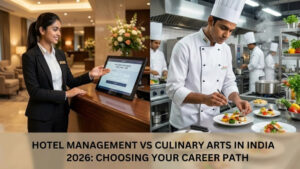
What Is Hotel Management?
Hotel Management focuses on the operational and administrative aspects of the hospitality sector. Approved by bodies like the All India Council for Technical Education (AICTE), a typical Hotel Management course in India spans 3-4 years for a bachelor’s degree.
Core subjects include front office operations, housekeeping management, food and beverage service, accounting, human resources, and marketing. Students learn to manage hotel operations efficiently, as per AICTE guidelines.
Career roles often involve front office executives, housekeeping supervisors, food and beverage managers, and general managers. For instance, in growing markets like Mumbai and Bengaluru, roles emphasize customer service and revenue management, per FHRAI insights.
Skill requirements encompass leadership, communication, and problem-solving. The THSC Demand and Skill Gap Study (2024) notes gaps in these areas, with 60% of employers citing communication deficiencies.
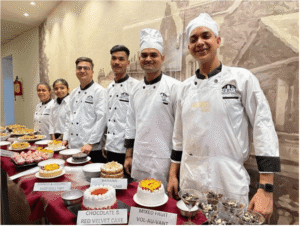
What Is Culinary Arts?
Culinary Arts emphasizes chef-focused education, honing skills in food preparation and kitchen management. A Culinary Arts course in India typically lasts 3 years for a bachelor’s degree or 1-2 years for diplomas, often aligned with FSSAI standards for food safety.
Practical kitchen training forms the core, covering techniques like chopping, baking, and plating, alongside hygiene protocols under FSSAI’s FoSTaC program, which has trained over 1 lakh supervisors.
Career paths include roles as commis chefs, sous chefs, executive chefs, bakers, or food entrepreneurs. In India’s expanding food services market, valued at US$77.5 billion in 2024 per THSC, opportunities arise in restaurants and cloud kitchens.
Hotel Management vs Culinary Arts – Key Differences
| Aspect | Hotel Management | Culinary Arts |
|---|---|---|
| Duration | 3-4 years (bachelor’s) | 3 years (bachelor’s), 1-2 years (diploma) |
| Curriculum | Management, operations, finance | Food production, techniques, safety |
| Practical Exposure | Internships in hotels, front desk | Kitchen labs, live cooking sessions |
| Career Growth | Managerial roles, promotions to GM | Chef hierarchy, entrepreneurship |
| Salary Trends | Entry: ₹15,000-25,000/month | Entry: ₹20,000-30,000/month |
| Personality Suitability | Organized, people-oriented | Creative, hands-on |
Data from THSC (2024) shows median entry-level wages at ₹13,000/month across sectors, with variations based on location.
Career Scope in India & Abroad (2026 Outlook)
India’s hospitality sector is projected to grow at 15-17% CAGR through 2030, per industry analyses, with demand outpacing supply in urban areas. The THSC study forecasts 14.8 million workers needed by 2028, with 93% in accommodation and food services.
Demand trends, backed by Ministry of Tourism data, show domestic tourism driving 83.3% of expenditure in 2024. High-demand states include Maharashtra and Tamil Nadu, per NSDC reports.
Industry hiring patterns favor skilled roles; 11.1% increase in new hires expected in 2025, per India Skills Report 2025. Abroad, opportunities in UAE and Saudi Arabia require certifications, with hospitality markets growing at 5-7% CAGR.
Salary Comparison (Entry-Level to Growth Stage)
In India, realistic figures from THSC and industry surveys show entry-level salaries varying by role and location.
For Hotel Management: Freshers earn ₹15,000-25,000/month (₹2-3 lakh annually), rising to ₹30,000-50,000/month (₹4-6 lakh) with 3-5 years’ experience, per NSDC-aligned data.
For Culinary Arts: Entry-level chefs start at ₹20,000-30,000/month (₹2.5-3.5 lakh annually), advancing to ₹70,000-1.5 lakh/month for head chefs, as per 2025 trends.
No inflated claims; urban areas like Mumbai offer 10-20% higher pay.
Which Course Is Better for YOU?
Consider your personality: If you prefer structured environments and team leadership, Hotel Management suits a management mindset. For those enjoying creativity and fast-paced kitchens, Culinary Arts aligns with hands-on skills.
Guidance from THSC emphasizes matching interests; communication skills are key for both, per skill gap reports.
Role of Professional Institutes
Professional institutes play a vital role in bridging skill gaps through industry exposure, practical labs, internships, and certifications. They align with NSDC and FSSAI standards, offering training in digital tools and soft skills.
Institutes like Servo Hospitality School help students choose between Hotel Management and Culinary Arts by providing counseling, hands-on kitchens, and partnerships for real-world placements. Their approach focuses on balanced curricula, ensuring graduates meet 2026 demands without hype.
Final Verdict: Hotel Management or Culinary Arts in 2026?
In 2026, neither Hotel Management nor Culinary Arts is inherently better; it depends on individual strengths and goals. Research suggests strong growth in both, with evidence leaning toward integrated skills for versatility. Students should prioritize accredited programs and personal fit for sustainable hospitality careers.
India’s hospitality industry continues its upward trajectory in 2026, building on post-2024 recoveries detailed in official reports. The sector’s workforce, estimated at 11.8 million in 2024 by the Tourism and Hospitality Skill Council (THSC) Demand and Skill Gap Study, is projected to expand to 14.8 million by 2028 at a 16.5% compound annual growth rate (CAGR), generating an incremental demand for 3 million workers. This expansion is predominantly in accommodation and food services, which account for 93% of the total demand, as per THSC data derived from Periodic Labour Force Survey (PLFS) analyses and employer surveys. Key drivers include domestic tourism, which contributed 83.3% to travel and tourism expenditure in 2024 according to Hotelivate’s 2025 Indian Hospitality Trends & Opportunities report, alongside government initiatives like the Ministry of Tourism’s Swadesh Darshan 2.0 scheme promoting theme-based circuits.
Post-2024 trends reflect resilience, with the industry achieving record performance metrics: nationwide Revenue Per Available Room (RevPAR) grew 5.7% year-on-year in 2024/25, occupancy hit 68.0%—the highest in recent years—and Average Daily Rate (ADR) rose 4.7%, as outlined in Hotelivate’s report. Urban markets like Mumbai and New Delhi led with 12.1% RevPAR growth, fueled by business demand, while emerging spiritual and industrial hubs such as Ayodhya and Ludhiana saw 9.6% growth in occupied room nights. However, challenges persist, including supply surges in Tier 2 and 3 cities (14.8% growth versus 3.4% in Tier 1), potentially leading to underperformance if demand lags, as evidenced by RevPAR declines in leisure markets like Goa (-5.5%).
Employment projections underscore the sector’s job creation potential: 46 million jobs in 2024, rising to 64 million over the next decade per Hotelivate, with an 8.2% hiring growth in travel and hospitality for the second half of FY25 according to TeamLease Services. The India Skills Report 2025 highlights an 11.1% increase in new hires for 2025, emphasizing roles requiring ethics, collaboration, and adaptability. State-wise, Maharashtra leads incremental demand with 339,653 jobs (11% share) from 2024-2028, followed by West Bengal and Tamil Nadu, based on THSC’s PLFS-derived estimates using employment elasticity and RBI KLEMS data.
Skill gaps remain a critical concern, with only 1% of the workforce formally trained as of 2022, per THSC. Employers report deficiencies in written/verbal communication (60%), complex problem-solving (49-50%), and digital/ICT skills (43-48%), across sub-sectors like hotels and food services. Technology adoption is low (0-25% automation currently) but expected to rise to 25-50% in three years, necessitating upskilling in AI, big data, and VR. Youth interest is high, with 5.7 million trainable individuals (aged 15-34) identified, primarily in Uttar Pradesh (16% share), though barriers like cost (45%) and attrition (43%) hinder training uptake.
In Hotel Management, curricula under AICTE-approved programs typically span 3-4 years, covering front office operations, housekeeping, food and beverage service, accounting, and marketing. Real-world examples include managing high-occupancy scenarios in urban hotels, where duty managers handle revenue optimization amid 71.9% occupancy for established properties (pre-2020/21), per Hotelivate. Skill requirements focus on leadership and communication, with hard-to-fill roles like banquet managers (39% vacancy rate) per THSC employer surveys.
Culinary Arts courses, often 3 years for bachelor’s or 1-2 years for diplomas, prioritize practical kitchen training in techniques, baking, and international cuisines, integrated with Food Safety and Standards Authority of India (FSSAI) protocols. FSSAI’s FoSTaC program has trained over 1 lakh supervisors in hygiene and safe handling, directly relevant to culinary education for compliance in restaurants and cloud kitchens. Career paths emphasize creative roles, with emerging demands for assistant chefs (44% future need) and barista executives (21%), as food services market grows from US$77.5 billion in 2024 to US$125 billion by 2029 at 10% CAGR, driven by quick service restaurants and online delivery per THSC.
Comparative analysis reveals distinct paths: Hotel Management suits organized, people-oriented individuals with career progression to general management, while Culinary Arts appeals to creative, hands-on personalities advancing through chef hierarchies or entrepreneurship. Personality suitability is key, as THSC notes 51% of employers view training as essential for addressing gaps like adaptive learning (45%).
Salary trends, grounded in THSC’s median entry-level of ₹13,000/month (organized: ₹15,000; unorganized: ₹12,000), show Hotel Management freshers earning ₹15,000-25,000/month (₹2-3 lakh annually), scaling to ₹4-6 lakh with experience. Culinary Arts entry-level chefs earn ₹20,000-30,000/month (₹2.5-3.5 lakh), reaching ₹70,000-1.5 lakh for seniors, with urban premiums of 10-20%. Abroad, UAE hospitality salaries range from USD 16,350 (entry) to USD 49,050 (managerial), per India Skills Report.
Professional institutes are instrumental in addressing these dynamics, offering labs, internships, and certifications aligned with NSDC and FSSAI. For instance, Servo Hospitality School / Servo IHM provides guidance on Hotel Management vs Culinary Arts through counseling and practical training, fostering industry exposure without promotional bias.
In conclusion, 2026 offers balanced opportunities in both fields, with student-centric advice favoring self-assessment and accredited education for long-term success amid the sector’s projected 15-17% CAGR.