
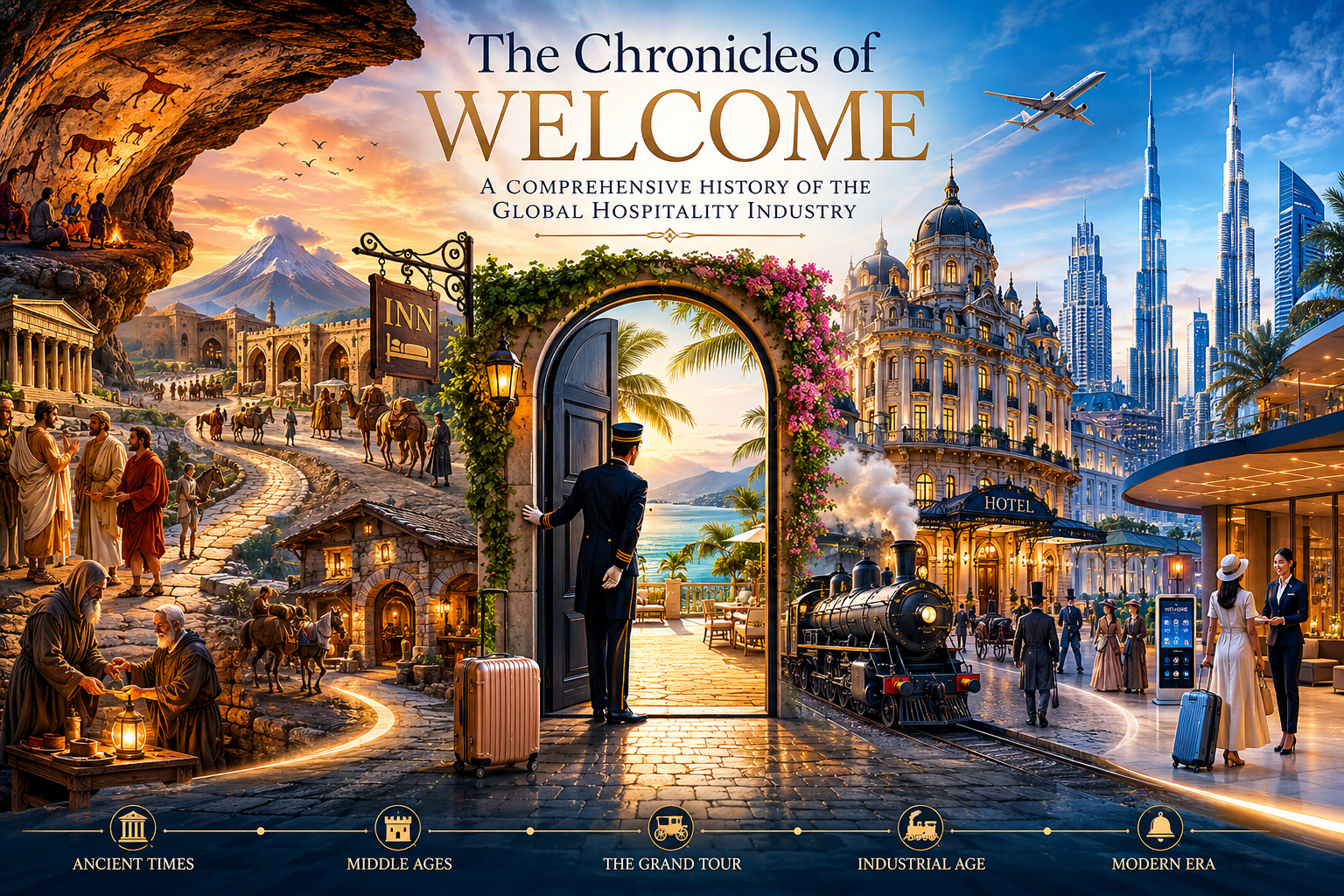
The Chronicles of Welcome: A Comprehensive History of the Global Hospitality Industry
The Chronicles of Welcome: A Comprehensive History of the Global Hospitality Industry
Think about the last time you checked into a hotel. You probably walked through automatic sliding doors, tapped your phone against a digital lock, and collapsed onto a crisp, white mattress. It feels effortless—a well-oiled machine operating entirely for your comfort.
Yet, this seamless modern luxury rests on an ancient foundation: the simple, vulnerable act of opening a door to a stranger.
Long before hospitality was a multi-trillion-dollar global industry driven by software and pricing algorithms, it was a survival strategy. The word itself comes from the Latin hospes, a beautiful, fluid word that means both “host” and “guest.” It reminds us that the two roles are deeply intertwined.
The story of hospitality isn’t just a history of buildings or balance sheets; it is the story of human migration, trade, and our evolving desire to feel at home in the world.

When Shelter Was a Sacred Duty (Ancient Times)
Even before history started Lascaux caves ( 38000 to 15000 BCE ) that are part of Unesco Cultural World heritage are considered to be the first shelter where both an artistic and cultural background as well as accommodation of people of different tribe can be proven
In the ancient world, stepping outside your home village wasn’t a leisure activity; it was an act of extreme courage. Travelers were usually merchants, soldiers, or pilgrims crossing uncharted territories plagued by harsh weather and bandits. Because a night spent outdoors could easily mean death, welcoming a traveler wasn’t a business transaction—it was a moral law.
The Laws of Heart and Hearth
The Ancient Greeks called this xenia—the sacred law of guest-friendship. Guarded by Zeus himself, xenia commanded that you must offer a traveler food, a warm bath, and a place to rest before you even asked their name or where they were going. To turn a stranger away was an insult to the gods.
Halfway across the world, ancient Indian culture took this a step further with the Vedic philosophy Atithi Devo Bhava: “The Guest is God.” Hosting a wanderer wasn’t just good manners; it was a form of worship. Families would give up their own beds and meals to ensure a visitor felt revered.
The First Practical Pitstops
As vast empires grew, hospitality moved from the home to the roadside:
- The Roman Highway: To keep their empire connected, the Romans built a network of state-run villas called mansiones for political couriers. For the everyday traveler, rough-and-tumble tabernae (taverns) popped up, offering basic food, cheap wine, and a stable for horses.
- Desert Sanctuaries: Along the dusty trails of the Silk Road, massive stone fortresses called caravanserais These were vibrant, bustling cultural melting pots where merchants from different continents could lock up their camels, secure their silks, and share a hot meal under the desert stars.
- The World’s Oldest Family Businesses: In the year 705 CE, a family opened a hot-spring inn near Mount Fuji called Nisiyama Onsen Keiunkan. That very same inn is still open today, run by the same family line for over 1,300 years—a breathtaking testament to the enduring human commitment to hosting.
Monks, Mud, and Merchant Guilds (The Middle Ages)
When the Western Roman Empire collapsed, the roads fell into disrepair, and Europe plunged into an era of isolation. Traveling became a terrifying prospect. With commercial inns disappearing, the flickering torches of monasteries became the only light in the dark.
Sanctuaries of Grace
Following the Rule of Saint Benedict, medieval monks viewed every knock on the monastery gate as a visit from Christ himself. They built dedicated hospices (the root word for both hospital and hospitality) to care for the poor, the sick, and weary religious pilgrims. Here, you didn’t need money; you just needed to be in need. The monks provided bread, ale, herbal medicine, and a safe floor to sleep on, entirely free of charge.
The Return of the Pay-Per-Night Inn
By the 13th century, cities were reviving, universities were opening, and merchants were trading across borders again. People needed a place to stay that wasn’t a church.
Private citizens began opening their doors for profit, giving rise to secular inns. To protect travelers from being cheated or poisoned, local governments and trade guilds stepped in. In 1473, the Innkeepers Guild of London was formed, creating some of the earliest rules for cleanliness, honest pricing, and guest tracking.

The Grand Tour and the Birth of “Style” (1500 – 1800)
As the world entered the Renaissance and the Enlightenment, travel transformed. It was no longer just about survival or survivalist trade; it became an art form.
The Era of the Coaching Inn
By the 17th century, scheduled stagecoach networks were crossing Europe like modern bus routes. Because horses grew tired every dozen miles, coaching inns exploded in popularity.
These inns were sensory overloads—smelling of wet hay, roasting meats, and pipe tobacco. It was here that the table d’hôte (the host’s table) was born. At a specific hour, a bell would ring, and every traveler staying at the inn would sit together at one long table to share a fixed-price, multi-course meal. It was noisy, democratic, and intensely social.
Elevating the Experience
By the 18th century, a new demographic emerged: wealthy young aristocrats embarking on The Grand Tour—a multi-year journey through France and Italy to study art and culture. These wealthy young elites refused to sleep on straw mattresses next to loud sailors.
To cater to them, properties began focusing on elegance, privacy, and fine French cooking. The English adopted the French word “hotel“ (which originally meant a grand, private town mansion) to separate these sophisticated establishments from the rowdy, mud-splattered inns of the past.
The Golden Age: Comfort Becomes a Science (The 19th Century)
The Industrial Revolution changed everything. Trains and steamships suddenly allowed thousands of people to travel at speeds their grandparents couldn’t imagine. Mass travel required a whole new kind of architecture.
The Hotel That Changed the Rules
In 1829, a building opened in Boston that would change hospitality forever: The Tremont House. Designed by Isaiah Rogers, it is widely considered the first truly modern hotel because it treated guest comfort as a system. The Tremont introduced mind-blowing innovations:
- Indoor plumbing with flushing toilets and baths
- Private bedrooms with actual locks on the doors for safety
- Free soap in every room
- Bellboys to carry heavy luggage
- À la carte dining, meaning guests could choose what and when they wanted to eat, rather than being forced into a fixed communal schedule
The “King of Hoteliers”
In Europe, the late 19th century gave rise to unparalleled glamour. The names César Ritz and Auguste Escoffier became legendary. Ritz, an impeccably polished Swiss hotelier, revolutionized service with a simple, radical mantra: “The customer is never wrong.”
Ritz put private bathrooms in every room, mandated that staff wear formal tailcoats, and played soft orchestral music in the lobbies. Meanwhile, Escoffier reorganized chaotic restaurant kitchens into a military-like hierarchy (the brigade system), ensuring food came out hot, beautifully plated, and perfectly timed.
In 1893, Switzerland opened the École Hôtelière de Lausanne (EHL). For the first time, hospitality wasn’t just a job you picked up—it was a prestigious craft you studied at a university level.

The 20th Century: The Democratic Explosion
If the 19th century built palaces for the wealthy, the 20th century opened the doors to everyone else. Post-WWII economic growth, family cars, and commercial aviation created an unprecedented boom in travel.
The Magic of Predictability
A businessman named Ellsworth Statler realized that the growing middle class didn’t want gold-leaf ceilings; they wanted value and consistency. Opening his flagship hotel in 1908, he pioneered mass-market hospitality with the slogan “A room and a bath for a dollar and a half.” Statler gave the world closet lights, morning papers slid under the door, and light switches right next to the entrance.
Soon after, pioneers like Conrad Hilton and J. Willard Marriott began buying up properties and building corporate chains, realizing that travelers felt comforted by familiarity.
The Holiday Inn Revolution
In 1952, a man named Kemmons Wilson took his family on a road trip and was appalled by how unpredictable, dirty, and overpriced roadside motels were. Frustrated, he founded Holiday Inn.
Wilson standardized everything. Every Holiday Inn had the same layout, the same clean beds, a swimming pool, and a rule that kids stayed for free. It gave American families the confidence to drive across the country, knowing exactly what to expect at the end of the day. By the 1970s, back-of-house computers began replacing paper ledger books, allowing desks to check guests in with a few clicks.
The 21st Century: The Return to the Human Connection
Today, we live in a world dominated by Online Travel Agencies (OTAs) like Expedia and home-sharing platforms like Airbnb. Anyone with a spare bedroom can become a host, forcing major hotel brands to ask themselves: What makes a hotel truly special?
The answer, it turns out, is a return to where we started. Modern guests are tired of generic, copy-paste hotel rooms. They want experiences.
Today’s leading hotels are focusing on:
- Frictionless Tech: Using mobile keys and AI messaging to eliminate lines, so employees can spend less time typing on computers and more time making real eye contact with guests.
- Authentic Local Flavor: Designing lobbies that feel like neighborhood coffee shops, serving local craft beers, and featuring art from local creators.
- Conscious Hospitality: Moving away from single-use plastics, using smart thermostats to protect the planet, and realizing that true hospitality cannot exist if it harms the local community.
The Unbroken Thread
From a crackling fire in an ancient Greek home to a sleek boutique hotel in a modern city center, the heart of hospitality has never shifted. The tools, technologies, and designs will continue to change, but the core essence remains perfectly timeless: a warm smile, an open door, and a safe place to rest your head.